Komodo Dragon Facts
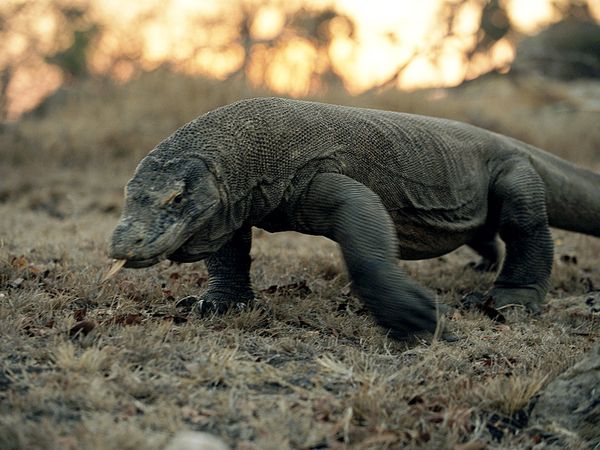
The Komodo dragon is the largest living lizard of our time, having adults
that can measure up to 3 meters in length and weigh 100-150 kg. Komodo dragon males are larger than females. These reptiles have a robust body, short but
strong powerful legs with claws and a long tail. As adults, their skin is brown-grey with very strong and powerful teeth that are 2cm in length, with
deadly bacteria contained in the saliva of the mouth.More information found here Like snakes, Komodo dragons have a forked tongue, which serves, together with a special organ, the Jacobson's organ, to obtain information about the surrounding environment for many purposes. They were first discovered in 1910 by dutch colonial administration Lietentant van Steyn van Hensbroek when he heard rumors about a "land crocodile". They are found on the Indonesian islands of Komodo, Padar and Rinca, and a small number are also found on Flores island. They prefer dry and
hot areas with open glassland, savannas, and tropical forests at low elevations and shrublands.
More information found here
 |
| Kingdom: Animalia |
| Phylum: Chordata |
| Class: Reptilia |
| Order: Squamata |
| Suborder: Sauria |
| Family: Varanidae |
| Genus: Varanus |
| Species: Komodoensis |
More information found here
In the wild, Komodo dragons are generally solitary animals, except during
the breeding season. Males maintain and defend a territory and patrol up to
1.2 miles (2 km.) per day. Territories are dependent on the size of the
dragon. Feeding ranges extend further and may be shared with other males.
A dragon will allow other dragons to cross its territory when they are on a
food run. The Komodo is a carnivorous and cannibalistic and it has a
prodigious appetite. They regularly kill prey as large as pigs and small
deer, and sometimes water buffalos. The life expectancy of a Komodo is
between 20 to 40 years. Komodo dragons are also part of the endangered
species list from human interference and volcanic activity.
More information found here
Pathogens and toxins in the saliva
- P. Multocida
- P. Aeruginosa
- Gram positive
- Gram negative
- anaerobic
- aerobic
- microaerophilic
- facultative
More information found here
