The Seven Wonders of the Ancient World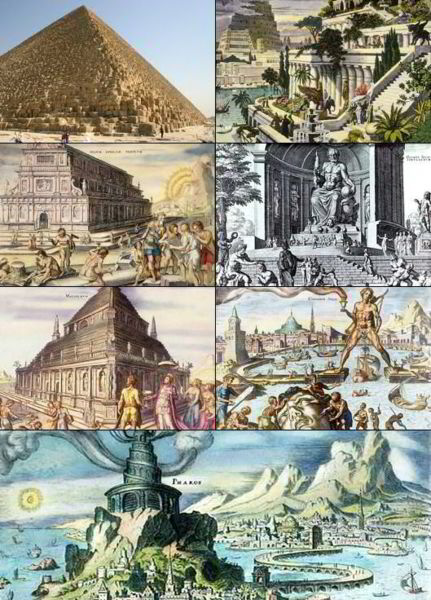 |
|---|
| The Seven Wonders Of the Ancient World is a list of seven monumentous structures built in ancient times. Currently all but one of the structures have collapsed or has been destroyed. The one remaining structure is the Great Pyramid of Giza, the oldest of all seven. |
The Great Pyramid of Giza |
| The Great Pyramid of Giza is the great pyramid at the city of Giza, a necropolis of ancient Memphis, and the current Greater Cairo, Egypt. This does not include the Great Pyramids of Giza, only the Great Pyramid of Khufu. It was built over a 20 year period by the pharaoh Khufu of the Fourth Dynasty around 2560 B.C. to be his tomb. However, it is unsure how they were built. It is the oldest and only standing Wonder of the Ancient World. [1]  |
The Hanging Gardens of Babylon |
| The Hanging Gardens of Babylon were wonderful gardens built by the Babylons, but also has little information about it. The most detailed descriptions come from ancient Greeks. The Babylonian records have no mention whatsoever of the gardens. A descriptive account was given by Strabo and Philo: "The Garden is quadrangular, and each side is four plethra long. It consists of arched vaults which are located on checkered cube-like foundations. The ascent of the uppermost terrace-roofs is made by a stairway..." "The Hanging Garden has plants cultivated above ground level, and the roots of the trees are embedded in an upper terrace rather than in the earth. The whole mass is supported on stone columns. Streams of water emerging from elevated sources flow down sloping channels" "These waters irrigate the whole garden saturating the roots of plants and keeping the whole area moist. Hence the grass is permanently green and the leaves of trees grow firmly attached to supple branches. This is a work of art of royal luxury and its most striking feature is that the labor of cultivation is suspended above the heads of the spectators." [2]  |
The statue of Zeus in Olympia |
| The statue was a massive 40-ft statue built around 440 B.C. in the temple of Zeus. The statue survived for many years, including transport to a palace in Constantinople. It was eventually destroyed by a fire. The statue itself had barely fit in the temple of Zeus, and was sometimes critisized for it not being proportional to the temple. Since he was sitting in the statue if he had stood up he would have unroofed the temple, which had inspired many poets at that time. The base was 3 ft. high and 20 ft. wide. [3] |
The Temple of Artemis at Ephesus |
| The Temple of Artemis was called the most beautiful structure on Earth by those who visited the temple. It was built in honor of the Greek goddess of hunting, wild nature, and fertility, at the ancient city of Ephesus near the modern town of Selcuk. The temple was referred to as the great marble temple, or temple D, and was built around 550 B.C. On July 21, 356 B.C., a man named Herostratus burned down the temple in an atempt to immortilize his name, and succeded. This was also the day Alexander the Great was born. The next 20 years were spent rebuilding the temple that was called temple E. Alexander also aided in the rebuild after he conquered Asia Minor. This temple was destroyed by the Goths in 262 A.D. It was rebuilt again, but torn down again by St. John Chrysostom. It was never rebuilt.
[4] |
| The Mausoleum in Halicarnassus |
| The Mausoleum is like the Great Pyramid in being the burial place of an ancient king, but was vastly different. The beauty was what got its reputation, not its size. It was rectangular in plan, the base dimensions being about 40 m by 30 m. There was a stepped podium hosting the tomb and sarcophagus. It was destoryed by several earthquakes and what remains was put into a castle built by crusadiers. [5] |
| The Colossus of Rhodes |
| The Colossus of Rhodes was a massive statue one hundred and ten feet high standing on a fifty foot pedisatl located near the harbour mole. It has been popularly depicted as spanning the entrance so ships could pass underneath but instead stood upright while nude, wearing a spiked crown, with its right hand shading it from the sun, with a cloak over its left hand. The statue lasted for only fifty six years before an earthquake struck the statue down. [6] |
| The Lighthouse of Alexandria |
| The Lighthouse of Alexandria was the only wonder of the ancient world to have a practical use as well as elagance. It ensured a safe return to the Great Harbor. At its time it was also the tallest building on Earth. But what scientist greatly facinate was the mirror that reflected light and could be seen 35 miles off shore. The mirror had been accidentally broken, but was never replaced. Later earthquakes in Alexandria struck the lighthouse but did little damage. Eventually two earthquakes in 1303 and 1323 caused the structure to become unenterable. By 1480 the structure had collapsed, but a medival fort was built on the exact spot of the lighthouse using stone from the lighthouse. It was 384 feet tall, the same size of a 40-story building. [7] |
| Last Updated: 11-15-2010 by William |